Archive for the ‘Personal’ Category
Travelling, again
And this time, I am going up, north, to the hills. Almost 2700 Kms from here, one way, on rail. Will write more.
And, I have just posted 2 new entries, below.
“Measure for Measure” at Rangashankara
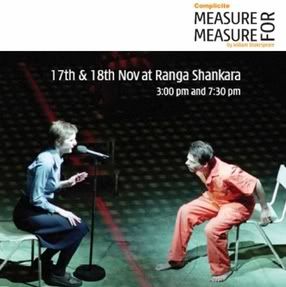
I wish and I hope that I am able to watch this at Rangashankara sometime in the next couple of days. More information, here.
Update: [17 November 2005, 1910 Hrs] All tickets sold out :-(
The world that ceased to exist
The rain kept on pouring on the bus, in all forms. There were brief periods when the breeze had some private moments with the bus, but overall, the rain intruded most of the time. I could see the windshield and have the driver’s view on some occasions. The wipers kept working overtime.
The view on the Driver’s rear view mirror often revealed the grinning face of our driver. The smile showcasing the bright white set of teeth in the darkness. The smile that also managed to hold a lit bidi that was an important accessory with this man who had already driven us close to 300 kilometers. The same smile that probably had a few hundred stories behind it. Stories that were an important aspect of his life (and probably someone else’s life too), for they fuelled the fire in him to drive 17 hours a day.
I chose to turn my face towards the window. Droplets of water decorated the brown glass pane on my right. The city cars zoomed past, leaving behind a tail of colorful lights, owing to which, the droplets of water, for a moment or two, acquired the effect of hundred mini-rainbows.
And when not mini-rainbows, they were the stars. Small, silvery, glittering and existing within my hand’s reach. I was so much in my own little world. Isn’t that what everyone wants? Isn’t that what you want?
But then the bus stopped, and the imagery acquired a different shape. A beggar child, in the bare minimum of clothes, both hands on the window of a car. His workplace, this muddy, traffic congested road. His plea, in his eyes. His desperations, too many to count. His thoughts, he could not afford.
His hands on the window’s glass were taken to be intrusions into another world. His gestures were met with hatred. On an open window, the glass made way up, securing the world of someone inside. Nothing, but a pure matter of convenience.
If I could make eye contact with the child, all I had to offer was another pair of cold eyes.
The difference between his world and mine? A Glass Pane.
Then I noticed, it was only the breeze now — the rain had gone and so were the droplets. My world looked so bleak without those stars.
My little world now ceased to exist.
PS: Thank you, Mr.Nair, for your suggestions on this.
Mangalore to Goa
1200 Hours- Just off Mangalore, from the Mangalore – Mumbai Matsyaganda Express, Konkan Route
It was 7 in the morning when I reached Mangalore. The dawn reminded me, much to my disappointment, of Bangalore, the city I had boarded the bus from. The same grey sky, some drizzle and mist in the air. The plan had been to spend the day at Mangalore before going to Udupi by late evening and catching the train to Goa, my home, the following morning. But a first look at the sky and immediately I knew — my plan had backfired. What I hoped to leave behind, I had not. Gloomy morning was very uninviting and the sea, it was far away.
But hope remained. Something in me wanted to stay as per the original plan. And why not, I had waited for this trip quite a long time and had been looking forward to it. I managed to reach the nearest bus stop and asked for the bus to Ullal beach. Number 44, they said. I waited. Bus 43 came and Bus 45 went by. No luck. By that time the drizzle had transformed itself into pouring rain. Ah, I saw Bus 44 coming. It zoomed by me even though I had gestured for the driver to stop it. He gestured me to go away. Just go away. I think he even said that in Kannada.
The rain did not stop. I went back to the railway station, my base camp. Got myself a platform ticket. I prefer to eat at the railway canteen when I am alone in unknown cities. First, I can eat lavishly without thinking too much about the pocket. The food is never bad. Secondly and more importantly, I make it a point to strike up a conversation with someone from the canteen staff. They are the best people who can tell you about the city and since they talk to all kind of travellers, language is never a problem. As I ordered my tea and bread omelette, the canteen manager gave me, as I realised later, the most important piece of advice at that time– Take the first train from Mangalore to Goa, Matsyaganda Express at 11AM and GO HOME.
Cancelled my ticket from Udupi to Goa and decided to board the Matsyaganda express that was to start at 1100 Hrs and should take me home to Goa by late evening. And here I am, writing this on the train, leaving the edge of Malabar on to a journey to the Konkan Route, a known terrain to me.
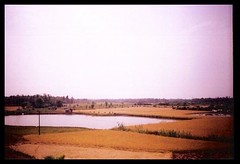
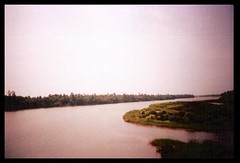
1645 Hours — Just off Karwar, the last Karnataka station before the train touches Goa
A little after Udupi, sunshine welcomed me. Rather, I should say, I welcomed the sunshine. It was as if, the bus driver of route 45, the canteen manager and the rain gods conspired against me and made me come here. After being deprieved of sunshine for almost 3 weeks in Bangalore, it was a relief to see the Golden Globe. Droplets of sweat appeared on my forehead and I did not mind it at all.
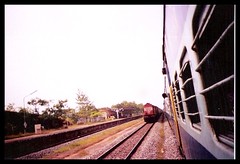
Now, as the train goes through Konkan, the coconut tree count tends to increase, the tunnels, some as long as 3 Kms, come and go. My age old custom of switching on the lights of the compartment in the daytime, has been invoked.
The rivers are full of water. Greenery is in abundance. The Sun sprays it’s rays and the dust appears almost Golden. The train enters countless and seemingly endless tunnels and when that happens, the smell of dampness overwhelms me, and my new found friend, the future hotel manager who comes from Bengal. We continue to talk about topics ranging from Fish names to Ganguly’s woes.
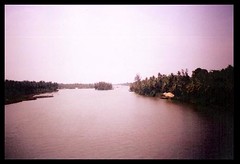
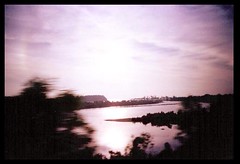
Goa is an hour away. Coming to Mangalore and bringing along the rain with me was certainly a bad idea or not, I do not know. In fact, who cares, now I do not want to know.
Happy Deepawali
Readers, Happy Deepawali.
Hope this year is great for the people of Blogosphere, for you all — The readers I know, the readers who post comments and the readers who follow this blog but prefer not to comment.
I am travelling right now, will post something on that soon.
Truman Travels
I have been travelling. There are quite a few of unreplied emails and comments I know, but please bear with me.
Will update soon.
Please read
I dug up this from the rediff.com archives.
In a link that I will soon reveal, Amitava Kumar, in a column written in 1999, asserts that most Indian writers in English, are reporters to the west.
Barring Arundhati Roy, of course.
Now, I hope that you have read Arundhati Roy’s essay “The End of Imagination”.
An excerpt:
The jeering, hooting young men who battered down the Babri Masjid are the same ones whose pictures appeared in the papers in the days that followed the nuclear tests. They were on the streets, celebrating India’s nuclear bomb and simultaneously “condemning Western Culture” by emptying crates of Coke and Pepsi into public drains. I’m a little baffled by their logic: Coke is Western Culture, but the nuclear bomb is an old Indian tradition?
It is not anything else that I wish you read but this. Please take some time out and read it if you still haven’t. See for yourself, what you missed for 7 years.
And here, Amitava Kumar praises Roy’s stance and is also “slightly” critical of her.
If you shall need more matter on this subject, and something less emotional than Roy, please read about this book here.