Author Archive
We need more of this
I am not (yet) a fan of Vikram Seth, simply because, and forgive me for this, I have not read his work. But yes, over the years I have seen his books in almost all the bookshops that show some interest in the prose of Indian authors. One of them, “The Suitable Boy”, is the longest novel written by an Indian (The author took a decade to write it) and according the Wikipedia, its the 7th longest novel ever. But frankly, length of any book has never impressed me — infact, to me it is of the least significance.
For Indian writing, two events of prime significance happened earlier this month. Salman Rushdie’s “Shalimar the Clown” and Vikram Seth’s “Two Lives” were published. Seth’s new work almost made a silent debut amidst the fanfare Rushdie received.
But now, it appears, with all the interviews that Vikram Seth has given, add to it, his sense of humor and timing, I have a feeling he would end up impressing more people than any Indian author has done so in a long, long time.
The author launched his book in the 5 major cities of India. Starting from Chennai and ending it in Delhi, covering Bangalore, Kolkata and Mumbai in between. He gave interviews and came up with interesting and funny quotes like “I’m a slow writer and I respect trees” (when asked why he spent six years writing his latest book) and, here is more, “I will pretend to read from the book for a while and you take your photos,” (when asked for a photo session) and the best quote of all, here:
“what is important for a writer is when a reader is gripped by a book and delays his dinner to read a few more pages.”
That is just so true.
I have always believed that reading is something that helps build a better society, it is much more than just a way to ward off boredom. I hope the efforts Vikram Seth undertook will make people get up, take notice and read. We need more authors coming out, talking to people and signing autographs.
We need more of this.
Please read
I dug up this from the rediff.com archives.
In a link that I will soon reveal, Amitava Kumar, in a column written in 1999, asserts that most Indian writers in English, are reporters to the west.
Barring Arundhati Roy, of course.
Now, I hope that you have read Arundhati Roy’s essay “The End of Imagination”.
An excerpt:
The jeering, hooting young men who battered down the Babri Masjid are the same ones whose pictures appeared in the papers in the days that followed the nuclear tests. They were on the streets, celebrating India’s nuclear bomb and simultaneously “condemning Western Culture” by emptying crates of Coke and Pepsi into public drains. I’m a little baffled by their logic: Coke is Western Culture, but the nuclear bomb is an old Indian tradition?
It is not anything else that I wish you read but this. Please take some time out and read it if you still haven’t. See for yourself, what you missed for 7 years.
And here, Amitava Kumar praises Roy’s stance and is also “slightly” critical of her.
If you shall need more matter on this subject, and something less emotional than Roy, please read about this book here.
A quick post
Okay, a couple of things here.
For good writing lovers, check Outlook Magazine’s 10 years: anniversary special.
It has columns by Pankaj Mishra, Tarun Tejpal (of tehelka.com), Sagarika Ghose , Pico iyer, Sham Lal, Khushwant Singh and Gabriel Garcia Marquez, to name a few.
And trust me on this, at Rs 15, it’s a steal.
Secondly, for all those lucky souls who have not upgraded their “yahoo messenger” to the new, “yahoo messenger with voice”- please stay away from this new version. It has lots of bugs. To name a few:
1. Sign in, Sign off and then Sign in again- and zap, the application crashes. I have checked this on both WinXP and Windows 2000 machines.
2. Late message delivery. The messages, for some strange reason, are not delivered on time. It takes a while for the message to appear on the other side. It is not because of any firewalls, routers etc because till last month when I was using the old messenger, anything like this never came up.
Now, you might ask how do I know that the messages are sent late.
I talk with my colleagues on Instant messengers all the time, even though they are seated a couple of feet away from me.
Travelling in small-town India
I arrived here in the evening on a train that runs on meter gauge track. It takes almost 8 hours from Indore to reach here. The official time table indicates a little more than 6 hours, but I do not care since my train to Goa arrives past midnight. Whether this train pulls in at 5 PM or at 6:30 PM, I am hardly bothered since I have a lot of time to kill anyway.
I have travelled enough in this long, wide country to conclude that travelling by train in India is an important part of your syllabus if you think of India as a “full term course”. All the theory learned like “The diversity of the land”, “the different dialects in the speech” come to life when you travel in the train, second class. But meter gauge track is different. It’s like specialising in “small town India” and the villages. The usual trains pass by them with speeds of 110 km per hour as if flipping pages of the book and skipping small, not so important chapters. At the small railway platforms of these very same villages, the meter gauge track trains spend hours.
So we start our journey from Indore and pass on, the two of us, my friend $D and me, passing by stations like Mhow, where we have a stop of 45 minutes. A man sells Kachoris in a cardboard box. It is a long journey and food could be a problem so we eat what we get. By early afternoon we reach Kalakand. Everytime that I have passed through this station, I am reminded of the sweet. I am told the village name is Kalakand because it is famous for the sweet with the same name.
Lucky Ali sings “kitni haseen zindagi” in my ears.
The train stops at the slightest excuse it finds. We do not get annoyed, all this was expected. But we observe. We see villagers carrying huge loads of vegetables in the train. One corner of the coach smells of coriander. On the outside of the windows, hooks are attached, one by one. Some of these hooks carry small logs of wood while the rest carry big cans of milk.
We reach Khandwa at 6:15 PM. According to the timetable we should have been here an hour back.
$D’s train is a good 3 hours late so I have company before I catch the train that will take me to Goa at midnight. Our first stop is the railway canteen run by a bespectacled man who seems well educated and a nice person. Dressed in a simple, clean full sleeve shirt and a little stocky. We order tea and in addition, I order bread and omelette. After a journey like this, where there are no big stations and no food stalls, this is a treat. The man behind the counter continues to read his newspaper while his son, probably 10 years old, tries to engage him in conversations. His trials go in vain.
$D is bored. Unlike me, he does not carry a Walkman. Amidst of all the trains that come and go in front of us, he picks out Bangalore-Delhi Karnataka Express and goes in to roam inside the train while it stands on the platform. “The girls are beautiful inside”, he arrives at the conclusion after he comes back with a wide grin. Evidently, the Bangalore-Delhi culture is in full form inside the coaches. That is the only glimpse we see of the metro culture in one of the busiest rail junctions of Central India. I see $D enjoyed his short lived adventure.
The much sought after train to Bhagalpur arrives. $D finally leaves at around 9 PM. This main part of his journey shall take a good 36 hours more. He has a waiting list ticket. That means no guarantee of a seat. I do not have a confirmed seat for the journey either but Deepavali is around the corner and we are going to our homes to celebrate. Nothing else matters to us. Homecoming could not get better than this. That is the biggest joy.
I stay there, on the platform, sitting on a bench while listening to Six Pence None the Richer’s “Kiss me”. I just heard, my train is on time, a quarter past midnight. This train coming from Delhi and going to Ernakulam in Kerala, will go through the Konkan route and drop me home, Madgaon, in the next 24 hours.
The year was 1999. In the next two years that I went home from Indore via Khandwa, things did not change much. The meter gauge train to Khandwa continued to stop at the slightest excuse and continued carrying logs of woods stuck outside the window. The man behind the counter at Khandwa Station’s canteen continued to indulge himself with late evening newspaper reading while I always ordered my favorite Bread and omelette with tea. I looked at him and wondered if he ever recognised me. Don’t know why, but I hoped for that. But I do not think he ever did. And whenever he noticed me for those 3-5 seconds, each time, it appeared as a mere interruption in his evening newspaper reading project.
$D told me, nothing much has changed there, even now.
Things don’t change much in small town India.
Two things that work great
First is the FooBar2000 Audio player. foo and bar, as my friends from the computer science field will recognise, are two variables that are used extensively in syntax examples of the subject. But this is an Mp3 playing software that does its job nicely. It has no “jazz”, no skins, no “feel-good” look but it is probably the best Mp3 player that I have come across in terms of performance, memory usage (All it takes is a little more than 2MB of RAM– Compare that to 12 MB taken by Winamp and almost 30 MB consumed by iTunes!). It is highly configurable, and very flexible. You can download it here. And yes, highly recommended for techies. We all realise how much precious RAM is!
It will take time to get used to it but this is something that seems so simple yet packs quite a punch.
Second thing that has worked great for me is Coldplay’s X&Y album. Good music to the core. Chris Martin and the gang has come of age! With the burden of expectations on Coldplay, X&Y is genius work.
If you are into music of the U2, REM, Oasis kinds, I suggest you listen to this.
This album grows on you. It will take time to get used to it but this is something that seems so simple yet packs quite a punch.

[above: Foobar2000 playing ColdPlay’s X&Y]
Update:
Not swallowed in the sea written, composed, performed by Coldplay
Oh, what good is it to live
With nothing left to give
Forget, but not forgive
Not loving all you see
All the streets you’re walking on
A thousand houses long
Well, that’s where I belong
And you belong with me
Not swallowed in the sea,
Not swallowed in the sea.
Selection from Gandhi
“I do not want my house to be walled in on all sides and my windows to be stuffed. I want the cultures of all lands to be blown about my house as freely as possible. But I refuse to be blown off my feet by any. I would have our young men and women with literary tastes to learn as much from English and other world-languages as they like, and then expect them to give the benefits of their learning to India and to the world like a Bose, a Roy or the Poet himself. But I would not have a single Indian to forget, neglect or be ashamed of his mother tongue, or to feel that he or she cannot think or express the best thoughts in his or her own vernacular. Mine is not a religion of the prison-house.”
As evident, that was Gandhi’s message to all those who have come to believe that Hindi is our second language.
More here. Also on Wikipedia, here.
Frankly, I have not read enough about the Mahatama that I may arrive at a conclusion on him. But it saddens me when I see people of his own land attributing him with “majboori” (helplessness) while people in the west find solace in his words, his life and times. It is perfectly okay to have an opinion about someone but that opinion should be backed with fact, truth and rationalism- something which I see missing in all the people who have come to criticise Gandhi.
update: Check out Dinesh’s take here.
Slimes of India: Keeping everybody happy
So what’s the latest slime at The Times of India?
After being overly concerned about Sania Mirza’s sleeveless shirt and her skirt, could there be any better masala for The Times of India than the Chappell-Ganguly row!
I have always said- Good publications take a stand and stick to it.
But what does TOI do?
On wednesday, reports this in the print edition:

…and taking a U-Turn in under 24 hours, has this on the TOI website, Thursday:
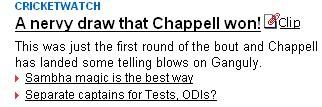
How convenient! What a way to make everybody happy!
Sick, cheap journalism.