Author Archive
Will Power
When I suggested my father, to get the sonography done because his stomach problem had dragged too long, I only echoed the words of my mother who had repeatedly asked him to do so. I had come to Goa, my home, during the vacations from Indore, where I had been studying for my BCA.
By the time sonography happened, I was back in Indore, studying for my exams.
In the brief long distance calls, I was unable to realise that something was wrong. Long distance calls were costly, the cellphone, still a toy of the rich, so it was usually my side of the story that made it through. How convenient it was, for me, to assume that everything was fine. Always had been fine, will be fine.
When maa told that Father was to be shifted to New Delhi, I thought something was serious. I was told there was an infection in his stomach, a “little” surgery had to be done. My sister was to be in Delhi, skipping her school.
In the conversations that followed, maa began to use the word “tumor” instead of “infection”.
Then one night, during a call, I asked Maa.
“Maa, is it cancer?”
The silence, followed by a reply that was bound by cluttered words formed by an unprepared mind, unfolded exactly what I had not been told all this while.
I paused.
I was instructed not to go there. Only after the exams, was I allowed to visit Delhi. Anything other than this, and I would end up adding to the despair my mother had been facing.
Two operations followed. Father had responded well after the second operation. His left hand was swollen with the IVs they had attached to him. There was no more space for thin, mean needles to go in, but it was okay with him.
It was all a matter of will power, he said.
Maa stayed 20 days (and nights) at the hospital, most of the times, sleeping on the bedsheet with a thin foam, on the floor. Not once did she complain. People asked her to let me skip college that year. Everyone expected my sister to repeat her tenth grade school the next year.
When I reached Delhi after my exams, I thought I would be staying with Maa, till the time Father was relieved. Instead, I was summoned to take my sister to Goa and was to stay with her as long as I could. No one was to skip an academic year, were Maa’s orders.
Apart from the support my father got from the family, it was the positive attitude that worked for him. And yes, Will power. The willingness to see through something like this, is half the battle won.
Today Father has fully recovered from Colon Cancer, all that remains is a scar on the stomach. But with that, he chooses to be reminded of his courage that made him look forward to life.
Kasauli
To arrive at this town, which has inspired writers like Kushwant Singh and Salman Rushdie, without a book, would almost be a sin, hence not only did I carry a Mistry book with me throughout, I was also able to take time out, reading the book whenever I could, in breaks, while sunshine sprayed on the hills.

The days are cold, the nights chilly. Wind blows on the hills from the west but they could be mistaken to be coming from anywhere, for this chill brings the senses to a halt.
This town, if it qualifies to be a called a town that is, is just what I had thought it to be. Calm, serene, at peace. People drop by the city, en route to Shimla, maybe just to fulfill a formality of visiting the place, so they could have a “been there, done that” written against Kasauli’s name in a certain diary. The “Glitter, Glamour” has all been stolen by Shimla, 60 Kms away, and that is precisely the reason why I chose to come here.
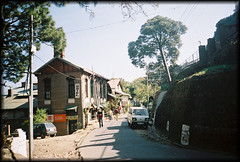
To be here, is to come home to solitude. Kasauli lets you be alone. It lets you sip a cup of Tea, alone on the pavement made of heavy stones, shining and polished by frequent walkers, as people go by their work. No one comes to you, asking you to look at the winter collection of clothes, no taxiwalla comes to you trying to allure you in one of those sight seeing rides. You are left alone.
But do not mistake this for unfriendliness on the part of the residents of this small town. Talk once, and they will open their world to you.
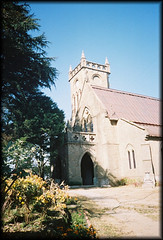
While the world has moved to multiplexes and malls, Kasauli has chosen to stay back. But not surprisingly, intrusions by a modern world are impending. Glimpses of it were evident as I saw Nokia Phones and Prepaid sim cards being sold inside small toy shops. And clearly, this town is not a fan of movies or it’s stars as I find no evidence or traces left by any bollywood release — no posters, no boards. In a small chamber that exists within one of the few narrow paths that constitute the demography of Kasauli, children play cricket, while behind the batsman is a hand pump, it’s cement cuboid base, serving the players as a makeshift wicket. The ball touching the other end of the wall, is of course, a boundary scored. Passer-by’s like me, act as the wicket keeper.
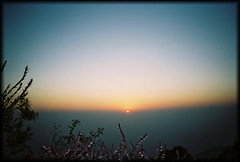
Evening comes and I return back to the Army Holiday Home, my “base camp”. On the edge, down below, I see the bed of mountains. Northwest of my view, I see Shimla slowly coming to lights and up above I see the even slower formation of a starry night taking over the reins from the Sun. The Sun that has hovered around these mountains of The Shivaliks, the lower range of the Himalayas, is now going down in a way as if choosing a mountain to find it’s abode in. It finally dims down, the mist and fog, giving it cover as it goes to the hiding. Orion is now clearly visible over my head. The wind blows harder, convincing me to go inside the warm indoors. Daisy, the German Shepherd, follows me to my room and stands at the door as if waiting for me to carry out a promise. I am reminded of the Breakfast I had shared with her in the morning. I realise we probably have a silent, mutual understanding. For dinner, I give her three slices of bread, the best I could offer. She walks away and I go inside, turn on the heater.
Travelling, again
And this time, I am going up, north, to the hills. Almost 2700 Kms from here, one way, on rail. Will write more.
And, I have just posted 2 new entries, below.
Too much of Google?
Last year we got gmail from Google. Wonderful concept of never being able to delete any of your email, ever. And the space keeps on increasing.
This year, of course, we got the Instant Messenger, Google Talk. No clumsy graphics, neat interface, ability to talk with anyone on the list by push of a button.
Google’s release of “Talk” was not expected by many. At least, not expected this early. So, in that sense, Google not only surprised the net community but also it’s competition.
It does not take much to see where this is all going. Google has unvealed it’s aggressive stance and they aim to take over the internet (and also the desktop) in more aspects than one.
Google’s strength, apart from this fact that they deliver software products that are easier to use by a typical PC user, lies in this fact that it is probably one of the most respected organizations in the market and certainly, the most respected software company, worldwide. All in all, People trust Google. I trust Google and odds are, that you too, do that.
But as I am habituated to take a skeptical stance on things like these, I can’t help but wonder how much does Google know about me.
Probably, a lot.
Besides the search engine, Gmail, Orkut, Blogspot, Talk and Desktop are all brands of Google. Gmail is the email service in which you never need to delete any email, Orkut is where you find people and communities, you can make like-minded friends, Blogspot is where you maintain your weblog, so you write about things that interest you (and do not interest you, for that matter), with “Talk” you can talk, literally, with your friends or message them the plain-old way and “Desktop” is the application you can use to speed up your searches on your PC. And that does not need an internet connection to work.
Add all this up, and Google knows what you talk about in your email (Gmail), your interests, your marital status, your age, the kind of people you like to be with (Orkut), your stands on issues, what you write (and what you read) while you blog (Blogspot), your friends you speak to on the messenger (Talk) and even the contents of the files on the Hard disk(s) of your computer (Desktop). And of course, your Google searches shall reveal if you are going to travel soon or not. By analysing the “googling” habits of people like me, it shall also reveal what computer language(s) do I work with.
What I wish to further focus on is the new Google project, called Google Web Accelerator. What does this do? Once you install this application on your desktop, It loads web pages faster than before, saving your time.
How does it do it? It stores copies of “frequently accessed pages” on it’s servers. Whenever you request a website on your browser (and you have Google Web Accelerator running), your request is sent to one of the Google’s servers which provides your browser with the latest copy of the website page that you wish to access. So in reality, your browser never actually accesses the website you requested. Only in the case when the website you requested is not there with Google’s server, will your browser actually retrieve the page from the intended website.
In essence, since all the web page requests coming from your browser go through Google Servers, Google shall not only know about all the websites you are accessing from your computer, you also run the risk of letting Google have the information that you fill in those forms over the internet, as in Google’s words, some sites “may” send the (form) information through Google. More of this, in Google’s own words, here. Remember, the forms that you fill on the internet usually carry personal information.
This concerns me.
This is alarming because never before has any internet based company offered so many services through a single account to the internet user. MSN and Yahoo!, the two companies who spiced up the internet wars in the late 90s and a good part of the post Y2k scenario until Google came are now reduced to mere followers. Clearly, Google has taken the lead.
Google’s biggest asset is the trust and goodwill it has with the internet community. I hope they never mess up that. And the “Google Show” is still on.
Meanwhile, think about what I said.
Grieve for the whistleblowers
In the middle of the Bihar election results, one news initially went without notice.
Manjunath, a manager with the Indian Oil Corporation (IOC), had ordered the closure of a petrol pump in Lakhimpur Kheri (State of Uttar Pradesh) sometime back. He was murdered.
The petrol dealers in the area never followed the norms. They sold adulterated fuel. Manjunath had the authority for closing these pumps down. Eventually he ordered the closure of three petrol pumps in the area.
Manjunath had informed his father about the area he was posted in. It was unsafe, full of gangs and a mafia order was in place. He told that he did not get “proper official support”. His father asked him to let some things “go by”. Manjunath resisted, insisting that he wanted to change things, this was his challenge.
As a student, Manju financed his own education. Perhaps, that goes on to say the kind of person he was.
As a graduage of IIML (Indian Institute of Management, Lucknow), Manjunath had the choice of leaving the job and getting himself something else, much safer and more attractive. It is the drive that fuels the majority of young professionals. But he chose not to. He wanted to change the system, giving all he can to his first job.
And this is what the system gave him.
Satyendra Dubey and now Manjunath. Anyone who knows our system would agree that what Manjunath and Dubey found out, was just the tip of the iceberg.
Is this what our political and administrative system gives to whistleblowers? Can the Government offer anything more than the condolences?
Links:
Friends of Manjunath have created a blog in his memory, here (I request you to please sign the online Petition in this regard, to the Prime Minister of The Republic of India, link to which is given on the blog) [Link via Sonia Faleiro]
Manjunath’s father, talks to the Indian Express, here.
Sonia Faleiro’s post here
Gaurav Sabnis, Manjunath’s junior at IIML, writes a moving post here.
On Indian Writing
Nilanjana Roy points out in her article, what I have always believed- that, Rushdie, Seth, Ghosh and Mistry have been the best that Contemporary Indian Writing has had to offer. Add to it, Authors like Jhumpa Lahiri and Suketu Mehta now having come of age, it is this group of writers, that will continue to provide the best in Indian writing for the next few decades.
Roy’s excellent article also mentions the (almost ironical) fact that most of the Indian writers have set up base outside India and continue to spend a good part of a year away from home. This same point has also been mentioned by Laxman Rao, who featured in Guardian’s (www.gurardian.co.uk) article.
Now that I have mentioned Laxman Rao, you may wonder who he is since the name does not seem to belong in literary circles. Laxman Rao is a Novelist who writes in Hindi. In the last 20 years, he has written about “18 novels, plays and political essays”, all in Hindi.
Laxman Rao does not stay outside India. He stays in New Delhi. He sells tea, on a road side tea stall, somewhere in south Delhi.
Rao asserts that to write about India, one has to stay here, in this country and write about the “India” every Indian knows. The words of Indian Authors who stay in foreign lands do not reflect the ground reality here. Read about it here. (Link from Indianwriting)
But then again, for our Authors to stay here, an encouraging market needs to exist. A good environment for literature, a book release and the world gives the Author the notice s/he deserves.
Also required is a “literary sense” existing within the masses. Of course, it does not live in our society. Instances of its absence were evident in the quality of questions asked by journalists while their mobile phones sang amidst Vikram Seth reading “Two Lives”.
Indian Literature is not (yet) in a state where we would ideally like it to be; but at least it hasn’t got any worse. In fact, I would assert that in the last 15 years or so, the overall state of Indian Writing has only improved. Some credit for it should go to Arundhati Roy’s Booker prize winning work, The God of Small Things and the Pulitzer prize winner, Jhumpa Lahiri’s Interpreter of Maladies. Of course, shortlisting of Rohinton Mistry’s Such a Long Journey (1991) and A Fine Balance(1996), for the Booker Prize, within a span of 5 years, has only helped the cause of Indian Literature.
Things are not too good, agreed, but they are not too bad either.
“Measure for Measure” at Rangashankara

I wish and I hope that I am able to watch this at Rangashankara sometime in the next couple of days. More information, here.
Update: [17 November 2005, 1910 Hrs] All tickets sold out :-(